ITF Monitoring Visit to Iraq and Syria
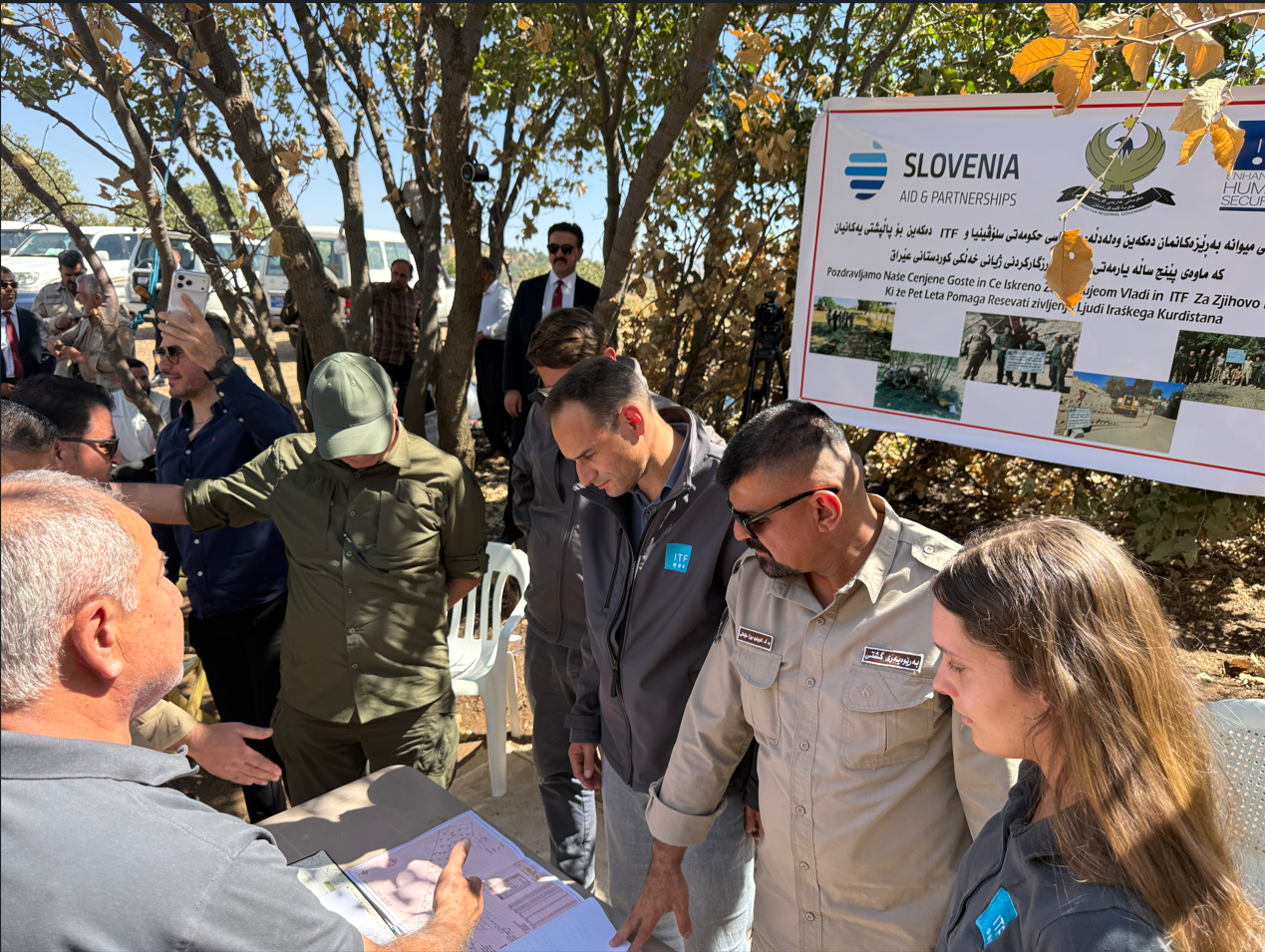
In September 2026, an ITF delegation travelled to Iraq and the northern part of Syria to follow the implementation of ongoing mine action programmes, meet with national authorities and partners, and see the work in the field.
Monitoring visits are an important part of how ITF works with its partners. They provide an opportunity to assess progress directly, understand operational challenges, discuss what is needed next and connect project implementation with the broader purpose of the work: reducing the risks that explosive remnants continue to pose to people and communities.
They are also an important opportunity for donors to see the results of their support first-hand. The Iraq visit was joined by H.E. Mr. Gorazd Renčelj, Ambassador of Slovenia to Iraq, representing the Republic of Slovenia, which supports ITF’s work with the Iraqi Kurdistan Mine Action Agency (IKMAA). Being present in the field allows donors to see how resources are translated into operational capacity, meet those implementing the work, and gain a more direct understanding of the context in which programmes are delivered.
Iraq: From Partnership to Field Operations
On 16 and 17 September, the delegation visited the Kurdistan Region of Iraq, where ITF works with IKMAA with support from the Republic of Slovenia.
The visit included a meeting with Mr. Safeen Dizayee, Head of the Department of Foreign Relations of the Kurdistan Regional Government, followed by discussions with IKMAA. ITF Director Ambassador Tomaž Lovrenčič and IKMAA Director General Mr. Jabbar Mustafa signed an extension of the Memorandum of Understanding between the two organisations, marking a further step in this long-standing cooperation.
The discussions provided an opportunity to look at the current needs of mine action operations, including the practical challenges faced by teams working in affected areas. Continued support remains important as national mine action capacities are maintained and expanded and as the remaining contamination is addressed.
The following day, the delegation travelled to Sulaymaniyah Governorate. At the active minefield, the team received operational briefings and observed mechanical demining in practice. The delegation also visited a completed minefield, seeing both the work that is still underway and the results of mine action in an area where clearance has been completed.
While in Iraq, the delegation also met with drivers whose work is supported through Slovenian funding. Their role is an important part of keeping mine action operations moving, from transporting personnel and equipment to supporting teams working in remote and challenging areas.
The two days offered a direct view of how institutional cooperation, donor support, technical capacity and field operations come together to address explosive hazards.
The Northern Part of Syria: A Closer Look at the Programme
From 19 to 22 September, the delegation continued to Syria to visit ITF’s local partner NGO Reachout and its mine action programme.
At an active battle area clearance site, the delegation received safety and medical briefings before observing demining operations. A casualty evacuation drill also demonstrated an essential part of the system supporting teams in the field.
The visit also included an explosive ordnance risk education session to former IDPs and demonstration non-technical survey. These activities provide an important link between mine action operations and the communities living with explosive hazards, helping teams identify areas of concern while providing people with information to reduce their exposure to risk.
The delegation also met with the NESMAC (a northern branch of Syrian National Mine Action Center), providing an opportunity to discuss the wider operational context and the role of national coordination in mine action.
At Reachout’s offices and training area, the programme was presented from a broader operational perspective. The delegation saw capabilities covering EORE and non-technical survey, demining, explosive ordnance disposal, search procedures and medical support. Practical demonstrations included an explosive demolition misfire drill, IED clearance and a semi-remote render-safe procedure.
The programme briefings also covered information management and Reachout’s mine action dashboard, as well as programme implementation and ongoing institutional capacity development. Taken together, the field and office visits showed the range of systems and specialised capabilities required to deliver mine action safely and effectively.
The programme in Syria is supported by the Republic of Slovenia, France and, most recently, the Republic of Korea. Their support enables ITF and Reachout to maintain and develop mine action capacities in a context where explosive hazards remain a daily reality for people living in affected areas, influencing where they can safely live, travel, work and access essential services.
Staying Close to the Work
The visit to Iraq and the northern part of Syria brought together several elements that are central to ITF’s approach: strong partnerships with national authorities and local organisations, sustained donor support, technical expertise and a clear focus on the people living with the consequences of conflict.
Seeing operations in person also provides a different perspective on the work. It puts project data and reports into their operational context – the environment teams work in, the equipment they rely on, the procedures they follow, and the decisions they make every day to carry out their work safely.
For ITF, this connection between strategy, resources, and implementation matters. The objective is not simply to complete activities, but to reduce security risks, strengthen local capacities, and help make it possible for people to live, move, work, and rebuild with fewer threats left behind by conflict.
Whether through a minefield in Iraq, a risk education session in Syria or the systems supporting teams behind the scenes, the purpose remains the same: to enhance human security by addressing the remnants of conflict and supporting people and communities as they recover and move forward.