Good News Story From: Syria - A Home Worth Coming Back To
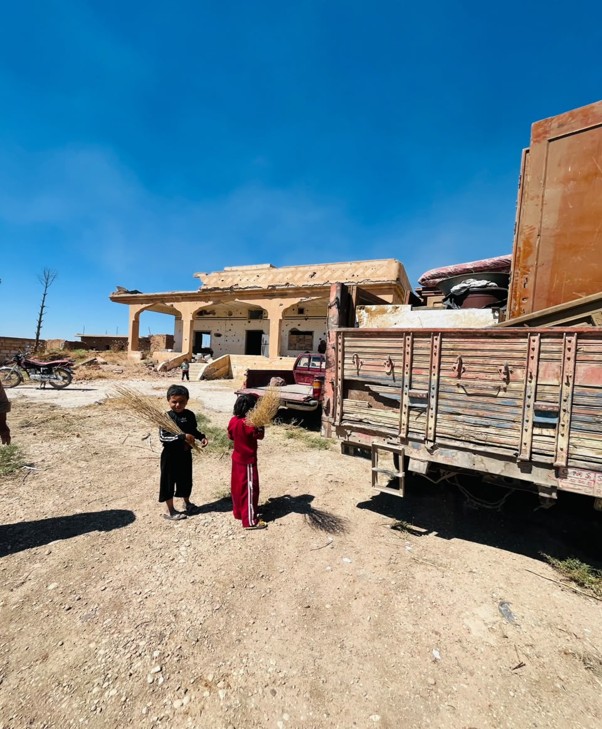
After years of displacement, three families returned home to find explosive hazards inside their houses.
They had reached their village. But their journey home was not yet over.
In Syria’s Al Hasakah region, returning families face the difficult task of rebuilding lives interrupted by conflict. The photographs accompanying this story show something of what that means: damaged buildings, vehicles loaded with household belongings, and children standing outside a house as the work of starting again gets under way.
There is a determination in these scenes that deserves our attention. People are returning to places they have been forced to leave, bringing what they can and preparing to make a home again. Yet among the damage left by war, some dangers are far harder to see.
Explosive ordnance can remain long after the fighting has moved on. For a returning family, entering a house, clearing debris or beginning repairs can expose them to a threat they may have no means of dealing with themselves.
That is why ITF’s and its local national partner Reachout’s work began before families left the displacement camps. Its risk education teams helped people understand the dangers they might encounter on their return: how to recognise a suspected explosive hazard, why they must leave it untouched, and how to report it. Safety information was also distributed along return routes, while clearance teams worked on priority roads and areas used by returning communities.
This gave families practical knowledge at a particularly vulnerable moment. After years away, familiarity with a village could no longer be taken as reassurance that it was safe.
When three families reported explosive items and improvised explosive devices inside their homes, Reachout mobilised its specialist teams.
Survey personnel assessed the locations and established the nature and extent of the hazards. Their findings informed the clearance teams, who then dealt with the identified explosive items and cleared the affected areas.
For the families waiting nearby, this was work with an immediate and deeply personal purpose. Before they could begin putting their homes in order, someone had to address the dangers inside them.
Throughout the operations, Reachout’s risk education staff continued working with the families at a safe distance. They explained how to respond if further suspicious objects were discovered around houses, elsewhere in the village or on agricultural land.
Clearance addressed the hazards that had been found; education helped families make safer decisions about those they might encounter next.
The families themselves were an essential part of that response. They reported the dangers. The teams listened and acted. That connection between communities and trained national personnel is central to effective humanitarian mine action.
The report records the families beginning to rebuild and arrange their homes after clearance. It is an ordinary activity with extraordinary significance when people have waited years to do it.
There is still damage to repair, and the wider threat from explosive ordnance remains. But the hazards identified in these homes have been dealt with, and the families have received knowledge that can help protect them as they continue rebuilding.
For those who support this work, that is a tangible result. Funding enables trained teams to reach communities, respond to reports, remove explosive hazards and deliver safety information when people need it most. Behind each operation is a household trying to recover some stability and a family making decisions about its future.
We rightly measure mine action through the land cleared, the hazards removed and the people reached. Those figures matter, but their meaning becomes clearest when we see what people can begin to do afterwards.
In Al Haskah region, three families have been helped through a dangerous stage of their return. Their determination brought them back to their village. And the ITF Reachout teams helped them take the next step towards making it home.
*Name changed for security reasons.
ITF expresses its appreciation to the French Ministry for Europe and Foreign Affairs and Slovenian Ministry for Foreign and European Affairs for their support and to all partners and donors whose cooperation enables this work.