Good News Story From: Syria - How Mine Action Is Helping Families Rebuild Their Lives
There are days in this work when the impact of what we do can be measured in numbers.
Square metres cleared. Risk education sessions delivered. Households supported. Beneficiaries reached. Reports submitted. Land released. Tasks completed.
Those figures matter, of course. They matter to donors, to headquarters, to planning staff, to operations teams, and to every organisation trying to make difficult decisions in a complex humanitarian environment.
But they are not the real story. The real story is always human.
It’s the story of a child walking through a field with his sheep. It’s the story of a farmer wondering whether the land his family depends on is safe enough to use. It’s the story of a mother trying to feed her children in a village that has already lived through more fear, uncertainty and loss than most people could ever imagine.
And sometimes, tragically, it’s the story of what happens when the danger left behind by war is still there, hidden in the soil, waiting for the innocent.
Recently, our teams learned of the case of 12-year-old Ali*, a young shepherd from a small village, south of Qamishli. While herding sheep in agricultural land, Ali found a suspicious metallic object, later identified as anti-aircraft ammunition. Like any child who had not been taught the danger, he did not know what it was. He did not know what it could do. He struck it with a stone.
It exploded.
Ali suffered serious injuries to his hand, chest and face.
That is not a good news story. It is a painful reminder of why this work matters. Because mine action is not just about explosives. It is not just about technical survey, clearance drills, demolition procedures, reporting formats or quality assurance. It is about preventing moments like that from reoccurring. It’s about reaching the child before curiosity does. It’s about making sure that “stop, do not touch, and report” isn’t just a slogan, but a message that has reached the people who need it most.
In villages across northern Syria, the legacy of conflict is still part of daily life. It is in the fields, on the tracks, near former military positions, and in places where families are simply trying to return to something that looks like normality. In rural communities, where people rely on agriculture, livestock and movement across open land, the risk is not occasional. It’s part of everyday survival.
That is why the work of ITF and Reachout matters so much.
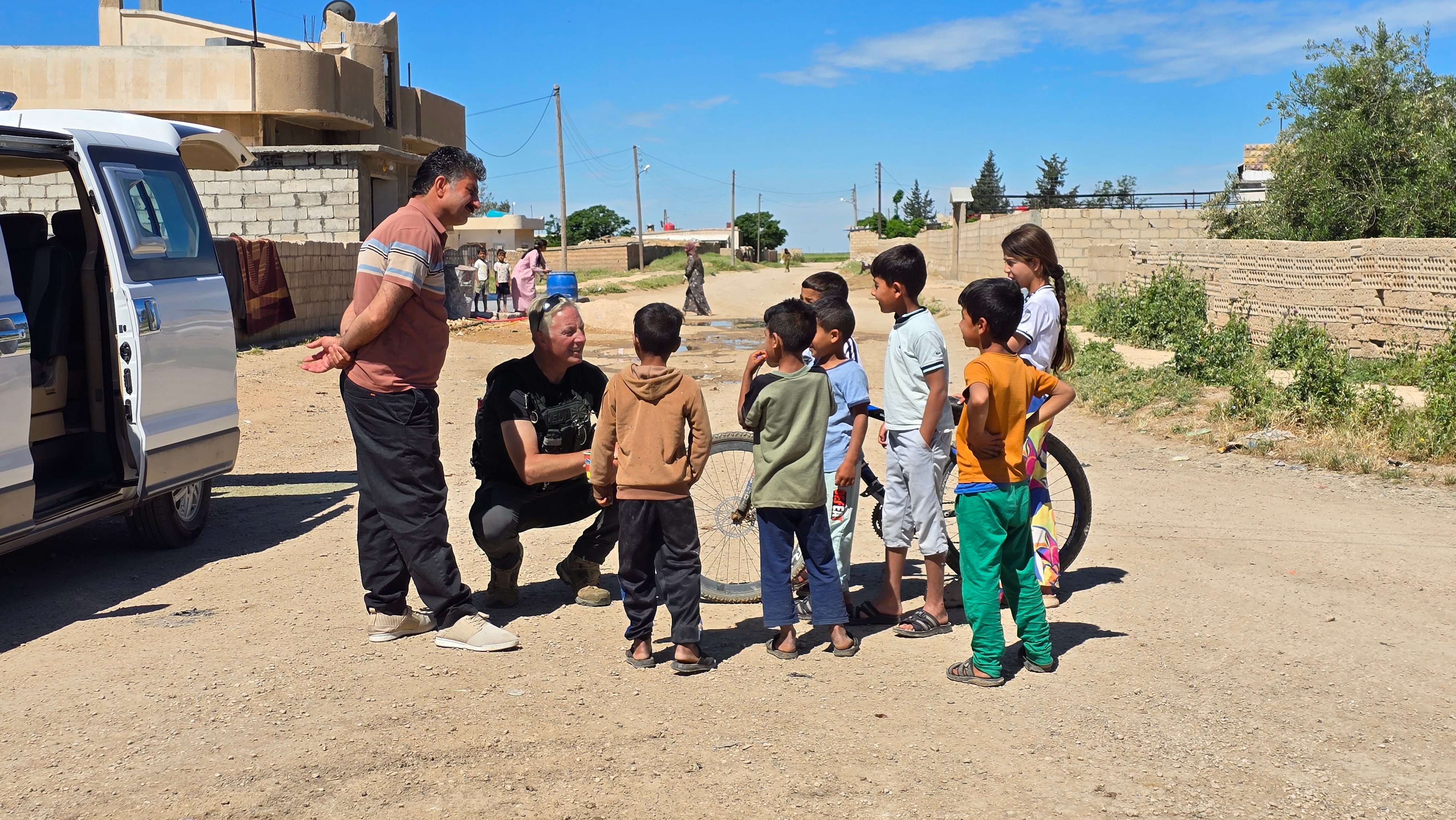
With the support of the French and Slovenian Ministries of Foreign Affairs, Reachout has been able to expand its mine action capacity in areas where communities have lived for too long with uncertainty and danger. Non-technical survey helps identify contaminated and suspected hazardous areas. Clearance teams reduce and remove the physical threat. Explosive Ordnance Risk Education teams go into communities, schools, homes and villages to speak directly to those most at risk, including children, shepherds, farmers and families whose livelihoods force them into dangerous areas.
This is not abstract humanitarian work. It is practical, immediate and deeply human.
A cleared field isn’t just a statistic. It’s a field a farmer can use again. A safe track isn’t just a line on a map. It’s a route to school, to water, to work, to family and to medical care. A risk education session isn’t just an activity delivered. It may be the moment a child learns not to pick something up. It may be the message that saves a hand, a life, or a family from grief.
And now, in Al-Hasakah, that same work is helping communities move beyond survival and into recovery.
One of the clearest examples of this is the ongoing Food Security and Livelihoods activity, which is specifically targeting communities previously cleared of landmines and explosive remnants of war. The activity was originally designed to support 35 vulnerable households through livestock assistance. But because of careful planning, transparent procurement, and a detailed financial and technical evaluation, the team identified an opportunity to extend that support to 50 households within the same available budget.
That matters.
It means that 15 more vulnerable families will now receive support than originally planned. It means more children, parents, widows, elderly relatives and struggling households will have a better chance of restoring a livelihood. It means that mine action is not simply removing danger and then walking away. It is helping create the conditions for life to begin again.
The selection process was also carefully managed. Additional beneficiaries were registered, and verification was carried out by M&E staff using established vulnerability criteria and a scoring system designed to ensure fairness and transparency. Before distribution, the livestock kits will be checked by a technical team including a veterinarian and a Food Security and Livelihoods Advisor, ensuring that what is delivered is suitable, healthy and in line with agreed standards. After distribution, the veterinarian will conduct follow-up visits to provide practical advice and guidance to the supported households.
That is what responsible humanitarian action looks like.
It’s not just giving something out. It’s making sure the right people are supported, in the right way, with the right checks, and with follow-up that gives the activity the best chance of creating lasting value.
For me, this is where the full story becomes important.
The tragedy of Ali’s injury shows us the cost of not reaching communities in time. The clearance, survey and risk education work shows us the practical response. And the livelihoods activity shows us the next step: helping families rebuild once the land is safer.
This is the true chain of recovery.
First, communities must understand the danger. Then the hazard must be identified. Then it must be reduced or removed. Then families can begin to use their land, move more freely, graze their animals, farm their fields, and rebuild a degree of confidence in the world around them.
That confidence is often the thing people forget.
When you have lived around explosive contamination, fear becomes normal. Parents worry when children leave the house. Shepherds worry when animals stray. Farmers worry when they plough. Communities avoid land they need because nobody can say with certainty whether it is safe. And when land cannot be used, livelihoods shrink, poverty deepens and recovery becomes almost impossible.
Mine action changes that.
It does not solve every problem. It does not erase the past. It does not bring back what has been lost. But it gives people something real to build on. It gives them safer ground. And in a place like Northeast Syria, safer ground is the beginning of everything.
I’ve seen many forms of courage in my life, in many difficult places. But one of the most inspiring and powerful forms of courage is the determination of ordinary families to rebuild after war. To return to land that frightened them. To send children back to school. To tend animals again. To plant, harvest, trade, travel and hope.
Our job is to help make that possible.
So yes, maybe this is a good news story after all. It’s good news because 50 vulnerable households are now being supported instead of 35. It’s good news because that support is going to communities where clearance has already helped reduce the danger. It’s good news because risk education teams are reaching people who may otherwise never know what to do when they find something deadly.
It’s good news because donors, local staff, technical teams, operations teams, M&E staff and community volunteers are all contributing to the same outcome.
And it is good news because in places where war has left fear in the ground, ITF and Reachout are helping families take careful, practical steps back towards normal life.
The work is not easy. It’s not always visible. It is rarely glamorous. But it matters.
It matters to the farmer who can return to his land. It matters to the shepherd who can move with greater confidence. It matters to the mother who now knows what to tell her children if they see something suspicious. It matters to the household receiving livestock support, not as charity, but as a chance to rebuild again.
And most of all, it matters because every cleared field, every risk education message, every household supported, and every child reached before tragedy strikes, is part of the same mission.
To protect life. To restore dignity. And to help communities move from fear to recovery.
*Name changed for security reasons.
ITF expresses its appreciation to the French Ministry for Europe and Foreign Affairs and Slovenian Ministry for Foreign and European Affairs for their support and to all partners and donors whose cooperation enables this work.